Episode 160
What MENA gets right about open finance, with Samer Soliman


Listen on


Across the Middle East, open banking has moved from policy paper to operational deployment faster than most outside observers realise. The UAE issued its first Open Finance Licenses to firms, including Startupbootcamp. Bahrain has been operating an open banking framework regulated by the Central Bank of Bahrain for several years. In this episode of the Fintech Garden Podcast, Samer Soliman — Group CEO of Arab Financial Services (AFS), Bahrain’s largest digital payments enabler — walks host Igor Tomych through what is actually being built, where the value is being captured, and why the MENA region offers one of the clearest examples of regulator-led open finance done deliberately. The conversation moves beyond the standard adoption narrative into the harder operational and strategic questions: who owns the customer, why open banking data is mostly unusable today, and what the marriage of AI with open finance actually produces.
Regulator-driven adoption is the MENA model — and it works: #
A persistent question in open banking is whether adoption should be pushed by the regulator or pulled by the market. Samer’s answer, grounded in two decades of operating across the region, is unambiguous. In MENA — specifically in markets like Bahrain and the UAE — the regulator drives, and that approach has produced better outcomes than the market-led alternative tried in other geographies. The reasoning is structural: the ultimate beneficiary of open finance is the end user, and waiting for incumbents to voluntarily share customer data they spent decades accumulating is not a realistic strategy. The regulator’s role, Samer argues, is to nurture the market into adoption rather than impose it on a hostile ecosystem.
Open finance is broader than open banking — and that matters: #
A distinction Samer is careful to draw. Open banking, as most European operators understand it, covers banking transactions and payment initiation. Open finance extends that perimeter to include insurance, wealth, and other regulated financial services. The implication is that the open finance ecosystem, when built with the broader scope from the beginning, produces more use cases and faster network effects than open banking alone. In the MENA region, the framework has been designed for the broader perimeter, which is why insurance premium personalisation, credit-scoring-on-demand, and account-aggregation-for-onboarding can all appear as concurrent use cases rather than sequential ones.
Three near-term use cases where the value is real: #
Samer is direct about where open finance produces commercial value in the next 24 to 36 months. First, payment initiation — moving money from one bank account to another without intermediary cards or networks, the simplest possible application of the framework. Second, credit scoring — particularly relevant for Buy Now Pay Later operators, who can use open finance data to make instant credit decisions without the traditional credit-bureau lag. Customers can know in advance whether a loan will be approved and at what limit, before submitting any application. Third, financial planning — including deposit facilitation and goal-driven savings products that can read directly from a customer’s broader financial picture. “Sky’s the limit,” Samer notes, but these are the use cases where the unit economics already work.
Customer ownership is up for grabs: #
The most consequential strategic insight in the conversation is that open finance dissolves the historical claim banks had on customer ownership. Until now, customer data sat inside a single institution and that institution effectively owned the relationship. With consent-based data portability, no one owns the customer by default. Whoever delivers the best experience and the highest value-to-cost ratio for the customer wins them — for as long as they continue to deliver it. The competitive equation shifts from “we hold your data, you stay with us” to “we earn your continued use of our front end every quarter.” This is the structural change most incumbent banks in the region are still adjusting to.
The unsexy truth about open banking data: #
This is the section of the conversation operators in every market should pay close attention to. Open banking, in most implementations to date, produces data that is broadly unusable for sophisticated decisioning. Samer’s illustration is precise. You walk into a supermarket. You buy electronics, medicine, clothing, and groceries. You pay one consolidated bill. The bank sees only the aggregate transaction. The supermarket knows what you actually bought, but does not share that line-item data. The result is that open finance, in its current form, often reasons over data that is too coarse to support the use cases vendors are marketing. Until item-level data flows alongside transaction data — which requires merchant cooperation, not just bank cooperation — the AI layer on top of open banking will reason poorly. Garbage in, garbage out.
Whoever knows the data first wins: #
A pattern Samer draws from outside financial services and applies inward. Google dominates internet behaviour. Apple dominates the hardware-plus-internet stack. Elon Musk’s Starlink went one level deeper — by owning satellite internet, it positions itself ahead of whatever happens on top, including Google. The same logic applies to financial services. The institutions that win the next decade are not necessarily the ones with the most data, but the ones that get the relevant data earliest in the decision cycle, before everyone else gets it. This reframes the open finance strategy from “we have a data lake” to “we are positioned at the point in the customer journey where decisions are actually being made.”
Marry AI with open finance — but understand the governance: #
When asked directly whether AI in payments is hype or substance, Samer is clear. The combination of AI and open finance is genuinely transformative — “boom,” in his exact words. Open finance provides the data pipeline. AI provides the speed and pattern recognition. Together, they enable financial decision-making at a scale and tempo that neither technology can produce alone. But — and this is the part operators tend to skip — both AI and open finance are governed environments. There is a regulatory layer around how data can be used, how consent is captured, and how decisions can be explained. The combination unlocks enormous capability. The governance constraints determine which capabilities can actually be deployed.
Prepare for winter during summer: #
A recurring theme is that open finance investments do not pay off in the period they are made. Samer is explicit that AFS, despite running an open finance platform, does not currently make material money from it. The investment is a hedge against the structural shift Samer expects within the decade: when customer behaviour moves toward open-finance-mediated decisions, AFS is positioned to participate in that flow rather than be displaced by it. The strategic principle is to build the capability during the quiet period, so it is ready when the market accelerates. Samer’s reference points are concrete: digital banking adoption sat at 30 to 40% for a decade, and then COVID pushed it to the majority in months. Open finance will follow a similar pattern.
Don’t rebuild what already exists: #
Samer’s closing advice to fintech founders is operationally specific. Technology will continue to evolve. The question is not whether to adopt, but how to adopt without overbuilding. The recommendation is straightforward: do not rebuild infrastructure that already exists in the ecosystem. Use what is available — payment platforms, identity layers, KYC providers, open finance hubs — and concentrate the build effort on the front end where the customer relationship actually lives. Customer loyalty attaches to the interface, not to the back-end. The fintech operators winning the next decade will be the ones who recognise that the moat is at the user-facing surface, not in reinventing the rails underneath.
Why listen: #
This episode is one of the more grounded conversations on open banking and open finance available in fintech right now, told from the MENA perspective by a CEO who is actively deploying the technology at scale. It is particularly valuable for operators in Europe, the UK, and Asia who want a non-European view on where this category is going, what the early commercial use cases look like, and where the unsexy operational problems sit. Samer’s combination of operator experience, regional pattern recognition, and direct opinions on what works and what does not makes the episode a useful map for anyone building, advising, or investing in open finance over the next two to three years.
Guest Appearing in this Episode
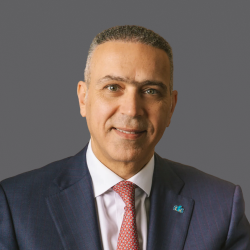
Dr.Samer Soliman

Group CEO of Arab Financial Services
Dr.Samer Soliman is the Group CEO of Arab Financial Services (AFS), the leading digital payments and fintech enabler in the MENA region. AFS is regulated by the Central Bank of Bahrain, owned by 37 banks and financial institutions, and serves more than 70 clients across over 20 countries. Samer joined AFS as CEO in January 2021, taking the company through its most significant expansion to date — including the recent grant of a retail Payment Services License from the UAE Central Bank, extending AFS's processing and acquiring footprint across Bahrain, Oman, Egypt, and the UAE. Before AFS, he served as Managing Director for the Middle East at Network International, where he led the region's acquiring and issuing business and implemented its growth strategy across the bloc. He brings more than 25 years of international experience across banking and payments, holds a Master's in Leading Innovation and Change from Robert Kennedy College in Switzerland, has completed the CEO Program at The Wharton School, and is currently pursuing a PhD in Business Administration.


Copy link
Stay ahead of fintech.
Harvest, expert interviews, podcast episodes, and selected industry updates—usually one email per week.